Showing posts with label islam. Show all posts

Friday, April 3, 2015

FIGURING OUT FIQH

Uh-oh.
Rules, rules and more rules.  

That’s what many people see the religion of Islam as - one big set of cans and can-nots.  

Yesterday a family friend who was visiting from the UK gifted us a box of chocolates. With my insatiable desire for anything sugar and cocoa, I lunged for the brilliantly gold-coloured box of Belgian beauties as soon as I had the chance.

But before I proceeded to greedily devour the joy that lay inside, I gave the ingredients a quick read just in case there was something dodgy in these heavenly bits of chocolaty goodness. 

And sure enough, just below where the main ingredients were listed, was a note in bold from the manufactures saying that these chocolates were infiltrated with alcohol.

Crestfallen, I alerted my family to this revelation and declared my intention to trash the now disgraced box of evil into the darkest, most deepest garbage bin I could find.

But much to my surprise, I was met with resistance.

“Don’t throw it!” exclaimed my grandma, incredulous that I would even consider throwing away uneaten food.

“We’ll give it to our neighbours. They’re Christian right? We can give it to them, they’ll enjoy it.”

Hold on a second.

Alcohol is prohibited because of its ill effects which are both physical and spiritual. Why would I subject my neighbours to these effects even if they consider it to be perfectly okay? 

“But it’s not haram for them!” retorted my granny. “The Jones would love a box of chocolate with a bit of booze. They drink in church every week anyways.”

Sharia, rules, fiqh, jurisprudence - call it what you wish - exists in order to create a morally upright society that is wired towards good and steered away from evil. 

Understanding that we can’t do certain things because it’s for our betterment is a huge step towards strengthening our faith. God doesn't make things impermissible just for the sake of it. Whether we can comprehend it or not, there is deep wisdom behind why we can or can't do things. 

It’s important to remember that the sharia is not meant to restrict us and make our lives boring or tasteless. Rather it’s a comprehensive code of conduct that serves as a guide by which we can live in order to achieve the highest levels of success both in this world and the next.

All it takes is a change of perspective. 

So tell me what you think. 

Would you have given those chocolates to your non-Muslim neighbours? 

Thursday, July 31, 2014

BOOK REVIEW: 101 WAYS TO CONCENTRATE IN PRAYER

Title: 101 Ways to Concentrate in Prayer 
Author: Dr. Ali Al-Hilli
Publisher: Sun Behind the Cloud Publications, UK
Pages: 191
Price: $11.99 / £6.99

In his book 101 Ways to Concentrate in Prayer, Dr. Ali Al-Hilli has gone above and beyond to offer a useful list of techniques that we can implement before, during and after our prayers in order to achieve higher levels of concentration.

Prior to writing his book, Dr. Al-Hilli conducted an anonymous online survey asking people how they would rate their concentration in prayer on a scale of 1-10 with one being poor and ten being perfect. 

The results were not surprising with 68% of people rating themselves between 1-5.

He then asked why they found it difficult to concentrate on their prayers to which 63% of participants replied that it was because their minds were always pre-occupied with other thoughts. 

Defining concentration
Dr. Al-Hilli starts by defining concentration in prayer as not just having as much attention as possible in what we are doing or who we are praying to, but also having the presence of heart. 

With that premise in mind, he guides the reader through the sacred journey of salaat, a voyage that begins well before we step on to the prayer mat. He divides the 101 tips into five categories - the prerequisites, the preparation, the prayer, spiritual upliftment, and finally medical and physical activities that can help improve our concentration in prayer. 

Research and religion
The book is rich with narration of the various mustahab actions that we can perform at the various stages of our prayers with everything from duas to be recited while we perform the steps of whudu to specific chapters of the Qur'an that are recommended to be recited in different prayers. 

Throughout his book, Dr. Al-Hilli strikes a wonderful balance between presenting ways to concentrate in prayer that are from purely religious sources like Qur'an and hadith, and tips based on contemporary research. He regularly draws on studies and books that have been written in the fields of concentration, memory, attention and productivity.

One such book he quotes is The Art of Concentration by Harriet Griffey. Griffey writes about how sitting still for a handful of minutes before carrying out a task can go a long way in increasing our ability to perform it the right way. These are tips we can easily apply to our daily prayers if we acknowledge that salaat is a rich and holistic process. 

Personal favourites 
One of the tips that stuck with me was #22 which states that we should strive to treat each prayer as if it is our last. It's a scary thought that the fajr salaat I hurriedly prayed a few hours ago could well be my last chance to call out to my Lord before I meet him.

Another one that stood out was #62: if you lose concentration, bounce back fast. Dr. Al-Hilli says, "If your focus during the prayer slips away, attempt to bounce back and use this as a warning and attention alarm to concentrate on the remainder of your prayer" (pg. 123).

What I liked about this book was how easy it was to read. The points flow smoothly from one to the other with some only being a couple of short paragraphs in length. The language and style that Dr. Al-Hilli uses is simple and relatable, and many of the tips he presents are practical so you can give them a shot straight away. 

Conclusion
All in all, 101 Ways to Concentrate in Prayer by Dr. Ali Al-Hilli is a fulfilling read that is sure to give you a fresh outlook on an act that we often turn into a ritual chore day after after. The author has given us the tools to derive maximum benefit from an act that is the 'pillar' of our religion, and it is now up to us to put them into practice and use what we can to reach higher levels in our salaat.  

Click here to watch a short promo video on the book or here to purchase 101 Ways to Concentrate in Prayer.  

Thursday, August 15, 2013

YAUM AL GHAM (the Day of Sorrow)

There is a mosque in Cairo where some believe the head of Hussain, the grandson of the Prophet Muhammad and the third of the Shia Imams, is buried. While these narrations are not authentic, there is still a great deal of reverence given to that place of worship by both Sunnis and Shias.

A few years ago there was talk from an extremist Salafist group to bring down the shrine in Cairo, saying that to venerate a monument in that manner was akin to polytheism.

Al Azhar University, the biggest Sunni seminary in the world, spoke out strongly and said that if so much as a finger was laid on that mosque, there would be dire consequences.

-----
Simply put, Jannatul Baqi is a cemetery in Saudi Arabia. But it wasn't always a barren graveyard. Not more than 88 years ago, a mosque unparalleled in its beauty and grandeur stood over the graves of the many sacred personalities buried there.  

Yaum al Gham (the Day of Sorrow) is the day true Muslims around the world remember when that grand mausoleum was reduced to sand and rocks. 

A section of Baqi today
Here are the ‘5 W’s’ of the Day of Sorrow

WHO - Spurred by venomous Wahabi (also called Salafist or Takfiri) ideologies, Saudi Arabia's king at the time, Abdulaziz Ibn Saud, ordered the demolition of Jannatul Baqi.  

WHAT - A stunning mausoleum in Saudi Arabia that housed the tombs of figures in Islamic history revered by both Sunnis and Shias was razed to the ground by bulldozers.

Four of the personalities buried there are those whom Shia Muslims regard as their Imams - the rightfully chosen successors to the Prophet Muhammad. One of those four is Muhammad’s other grandson, Hassan, who is Hussain’s older brother. The other three are descendants of Hussain.
 
Many other figures, including the Prophet's relatives, companions, and wives, which are revered by all Muslims around the world are also buried in Baqi.

The rest of the Shia Imams, numbering twelve in total, the twelfth of whom is believed to be occultation, are buried in grand mausoleums of gold in Iraq and Iran. All year round, millions of Shias from all parts of the world visit these shrines to pay their respects.

WHEN – The Baqi shrine was demolished on 21 April, 1925. The Islamic date was 8 Shawwal 1345.  

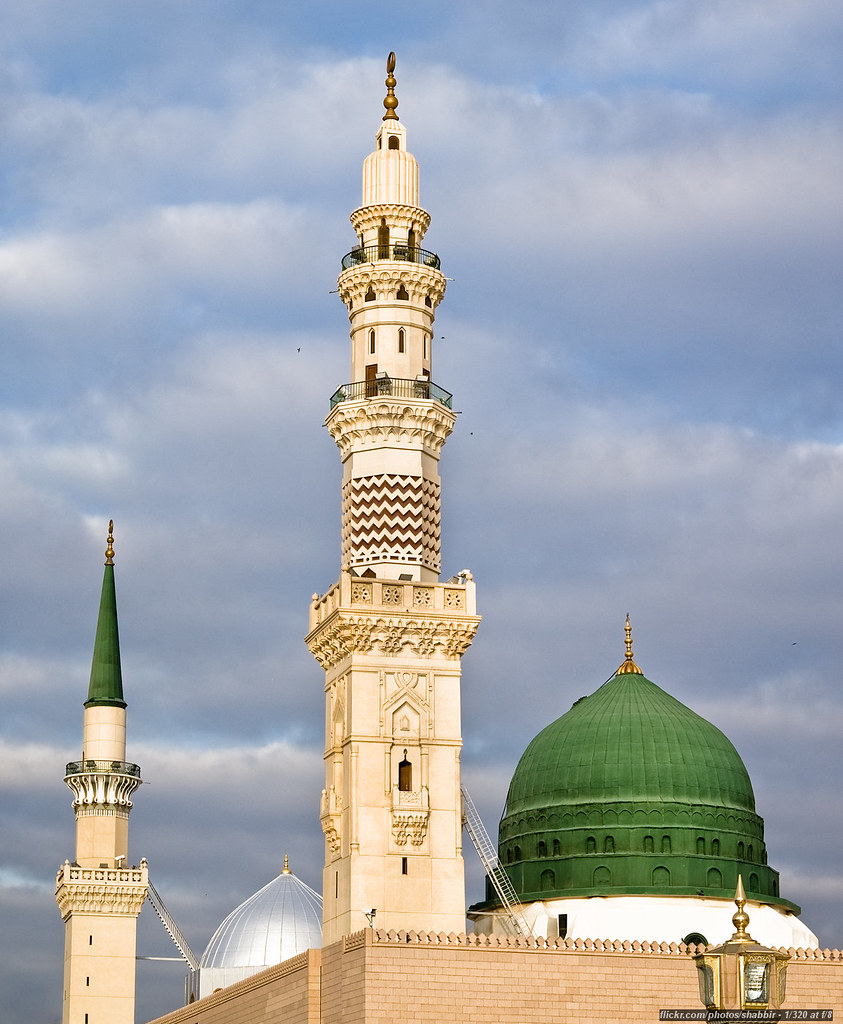
WHERE – Medina, Saudi Arabia. The graveyard of Baqi is located a stone's throw away from the green-domed Masjid Nabawi, one of Islam's most sacred mosques and the resting place of the Prophet Muhammad.

WHY- Among many things, Wahabis condemn grave veneration of any sort. Wahabism is a recently founded ultraconservative branch of Islam, criticized by mainstream Muslims both Sunni and Shia.

They say that history repeats itself and today, the holiest sites in Islam are still under attack.
The mausoleum of Hussain - Karbala, Iraq

In 2006 and 2007, the golden domed mausoleums of the tenth and eleventh Shia Imams in Sammara, Iraq were attacked in a bomb blast.

With Wahabism the dominant form of Islam in Saudi Arabia today, talks are rife to destroy many more of Islam's holiest sites - including Masjid Nabawi. 

Friday, September 28, 2012

JIHAD!

The Prophet's mausoleum in Medina, Saudia Arabia   
So a ‘nasty’ video about the Prophet Muhammad has apparently been causing quite a ruckus around the world.

Last week I talked myself into watching the 13 minute trailer of the ‘Innocence of Muslims’ on Youtube.

By the time I was done, I was surprised to find that I wasn’t overcome with a sudden desire to jump off my chair, yell ‘JIHAD!’ and lunge for the throat of the nearest Westerner. 

Nor was I left feeling angry or hurt.

Rather, I was left bemused by the fact that a pile of rubbish like this could actually cause as much noise in the world as it supposedly has.   

It’s going to take much more than a movie, if you can even call it that, for me to take offence about a man whose very life was a lesson for humanity (and whom I might add, I am proudly named after).

In his own lifetime, the Prophet had endured much worse than a joke of a production mocking his life. Take this short story for example:

There was an elderly, non-Muslim woman who lived beside the Prophet in Medina. Let’s just say she wasn’t his biggest fan.

To make her feelings known, she would attempt to drop her daily collection of trash on the head of the Prophet every time he would step outside his house walking through the alleys of Medina.

The Prophet never reacted until one day, he was walking and found that no rubbish came his way from the sky.

Surprised, he inquired about the woman to the nearby neighbours and came to find out that she had fallen ill. 
 
When he turned up on her doorstep, the woman was sure that Muhammad had come to take his revenge, or else insult her for her antics.

But instead the Prophet had come by to offer her his best wishes, and pray for her quick recovery. 

This same Muhammad who once said, ‘Pride enters the heart like an ant crawling onto a black rock at night’ is being portrayed as a womanizer and a crook in the ‘Innocence of Muslims’.

But that’s beside the point. The bottom line is that people are entitled to say whatever they want – Muhammad is greater than all of that and those who take Muhammad as their role model should be greater than that.

As for Libya, Egypt and Pakistan – I find it exceptionally hard to believe that a video clip can be the sole cause of all that’s been going on there recently.

There’s more to this than meets the eye, and the US’s willingness to meddle around anywhere that smells of oil or money has a little something to do with it.

And as for those Muslims crying out ‘Jihad!’ and feeling offended about the film – take a break and watch the thing. My Prophet would not have burned embassies and put bounties on people's heads. 

“I believe if a man like him were to assume the dictatorship of the modern world, he would succeed in solving its problems in a way that would bring much needed peace and happiness.

I have studied him - and the man in my opinion is far from being an anti – Christ. He must be called the Savior of Humanity.”

George BernardShaw on Muhammad

-----
A version of this article appeared in the online edition of Carleton University's student weekly, the Charlatan in September 2012.