Showing posts with label muslim. Show all posts

Thursday, July 31, 2014

BOOK REVIEW: 101 WAYS TO CONCENTRATE IN PRAYER

Title: 101 Ways to Concentrate in Prayer 
Author: Dr. Ali Al-Hilli
Publisher: Sun Behind the Cloud Publications, UK
Pages: 191
Price: $11.99 / £6.99

In his book 101 Ways to Concentrate in Prayer, Dr. Ali Al-Hilli has gone above and beyond to offer a useful list of techniques that we can implement before, during and after our prayers in order to achieve higher levels of concentration.

Prior to writing his book, Dr. Al-Hilli conducted an anonymous online survey asking people how they would rate their concentration in prayer on a scale of 1-10 with one being poor and ten being perfect. 

The results were not surprising with 68% of people rating themselves between 1-5.

He then asked why they found it difficult to concentrate on their prayers to which 63% of participants replied that it was because their minds were always pre-occupied with other thoughts. 

Defining concentration
Dr. Al-Hilli starts by defining concentration in prayer as not just having as much attention as possible in what we are doing or who we are praying to, but also having the presence of heart. 

With that premise in mind, he guides the reader through the sacred journey of salaat, a voyage that begins well before we step on to the prayer mat. He divides the 101 tips into five categories - the prerequisites, the preparation, the prayer, spiritual upliftment, and finally medical and physical activities that can help improve our concentration in prayer. 

Research and religion
The book is rich with narration of the various mustahab actions that we can perform at the various stages of our prayers with everything from duas to be recited while we perform the steps of whudu to specific chapters of the Qur'an that are recommended to be recited in different prayers. 

Throughout his book, Dr. Al-Hilli strikes a wonderful balance between presenting ways to concentrate in prayer that are from purely religious sources like Qur'an and hadith, and tips based on contemporary research. He regularly draws on studies and books that have been written in the fields of concentration, memory, attention and productivity.

One such book he quotes is The Art of Concentration by Harriet Griffey. Griffey writes about how sitting still for a handful of minutes before carrying out a task can go a long way in increasing our ability to perform it the right way. These are tips we can easily apply to our daily prayers if we acknowledge that salaat is a rich and holistic process. 

Personal favourites 
One of the tips that stuck with me was #22 which states that we should strive to treat each prayer as if it is our last. It's a scary thought that the fajr salaat I hurriedly prayed a few hours ago could well be my last chance to call out to my Lord before I meet him.

Another one that stood out was #62: if you lose concentration, bounce back fast. Dr. Al-Hilli says, "If your focus during the prayer slips away, attempt to bounce back and use this as a warning and attention alarm to concentrate on the remainder of your prayer" (pg. 123).

What I liked about this book was how easy it was to read. The points flow smoothly from one to the other with some only being a couple of short paragraphs in length. The language and style that Dr. Al-Hilli uses is simple and relatable, and many of the tips he presents are practical so you can give them a shot straight away. 

Conclusion
All in all, 101 Ways to Concentrate in Prayer by Dr. Ali Al-Hilli is a fulfilling read that is sure to give you a fresh outlook on an act that we often turn into a ritual chore day after after. The author has given us the tools to derive maximum benefit from an act that is the 'pillar' of our religion, and it is now up to us to put them into practice and use what we can to reach higher levels in our salaat.  

Click here to watch a short promo video on the book or here to purchase 101 Ways to Concentrate in Prayer.  

Thursday, April 18, 2013

KHARAB LAGSAAY (They'll feel bad)

"But they'll feel bad if we don't go!"

"Its just an extended family gathering, I'm sure it's fine."

"Everyone will be in hijab, so it's okay."

Ah, the conundrum that is mixed gatherings. To go or not to go, that is the question!

It's easily one of the biggest taboos in our communities today and in this post, I'd like to give my two dinars on it. I'll be drawing from what our scholars have said about the issue by referencing useful documents like this one.

Note: There's a small glossary at the bottom of this post for all you mzungus out there who can't tell the difference between a wiwa and walimo.

-----
So what do the scholars say?

Simple and straight, in gatherings where both sexes are expected to dress to impress, segregation between men and women with a barrier is to be observed.

Where mixed gatherings are allowed is in formal events like meetings, or when there is knowledge being disseminated. This is, of course, provided that hijab is observed.

Whether a partition like a barrier should be used or if it's okay for ladies and gents to simply sit in different sides of the room again depends on the situation.

Toronto's Syed Muhammad Rizvi has made a wonderful little chart regarding mixed gatherings. It's based on a series of discussions he had with Syed Sistani regarding mixed interactions between youths.

(click to enlarge)

I really like this line from that World Federation document:

"Islam does not allow free mixing between members of opposite gender but it allows decent and sanctified interaction."

-----
Wiwas!

Who doesn't enjoy attending weddings?

What with the endless supply of artery-clogging mitai and the reuniting of old relatives from half way around the world, it's a great time for everyone.  

But unfortunately it's usually at wiwas and the functions that come with them that the topic of mixed gatherings more often than not comes up.

Put it this way - when it comes to wedding functions, it's often the case that the ladies are dressed at their finest, and the men likewise. We've all seen it, shamelessly expensive clothes that make their first and last appearances at these functions. 

So think about it. 

If you put men and women together in a fancy hall with ambient lighting, add that little bit of 'halal music' that seems to be so fashionable today, and some kibao biryani and soda- all of a sudden you have a rather, what's the right word, loose social environment.

Thank God alcohol is haram. 

Put it all together and you might come to the conclusion that our ulema weren't just being unnecessarily strict when they warned against such gatherings.
 
-----
Would the Prophet attend?

A simple litmus test to gauge for yourself whether or not a gathering is one that is halal or not is this - stop for a second and think to yourself, 'can I imagine the Prophet (saaw) being present here?'

I know I wouldn't be surprised if I saw him at a mixed gathering where Islamic politics was being discussed.

But for some reason, the thought of the Prophet showing up at an 'Islamic' wedding function where men and women from different families mingle freely is laughable.

----
What to do?

If for you, religion comes before your family or friends, then don't go. And do that happily, knowing that your Lord and your Imam is pleased with you.

Congratulate the family on the occasion, and tell them, respectfully, that you don't take part in unnecessary mixed gatherings.

By attending, you're showing there's nothing wrong with events like that. There's no point going home after and discussing with your friends and family how un-Islamic XYZ's wedding was.

----
Parting thoughts...

I realize I may have hit a nerve or two with this article so I'd like to apologize in advance if I've hurt anyone. I'd also like to clarify that this post isn't directed at a particular family or wedding.

So leave a comment. Send me an email. Tell me what you think.

Do I need to relax and enjoy the show more?

Who knows, maybe I do.

----
Glossary:


mitai:  Sub-continental sweets. More calories per square centimeter than the population of the Gaza Strip.

hijab: the physical and spiritual veil to be observed by Muslim men and women.

halal: allowed by religion.

haraam: disallowed by religion.

biryani: just the best dish in the whole world.

ulema: scholar, learned one.

kibao: the best, amazing, baap!

wiwa: wedding

walimo: reception/dinner after wedding

ummah: Islamic community

mzungu: non-Tanzanian, foreigner.


Friday, September 28, 2012

JIHAD!

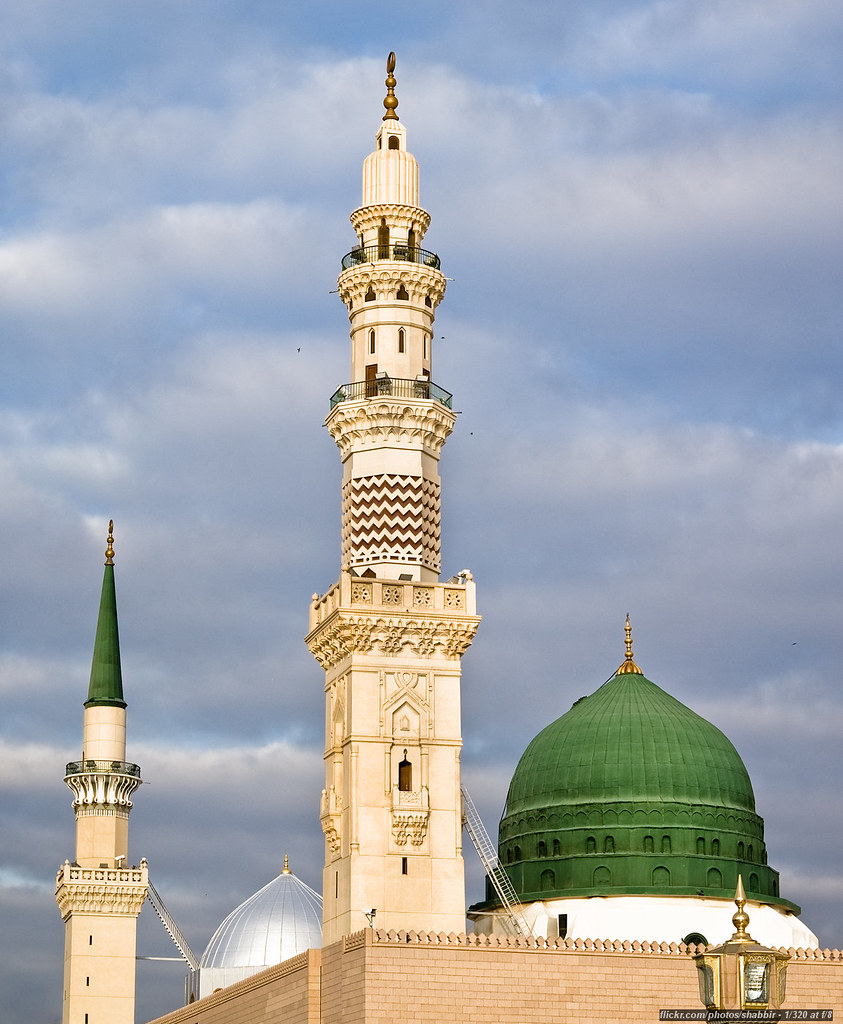
The Prophet's mausoleum in Medina, Saudia Arabia   
So a ‘nasty’ video about the Prophet Muhammad has apparently been causing quite a ruckus around the world.

Last week I talked myself into watching the 13 minute trailer of the ‘Innocence of Muslims’ on Youtube.

By the time I was done, I was surprised to find that I wasn’t overcome with a sudden desire to jump off my chair, yell ‘JIHAD!’ and lunge for the throat of the nearest Westerner. 

Nor was I left feeling angry or hurt.

Rather, I was left bemused by the fact that a pile of rubbish like this could actually cause as much noise in the world as it supposedly has.   

It’s going to take much more than a movie, if you can even call it that, for me to take offence about a man whose very life was a lesson for humanity (and whom I might add, I am proudly named after).

In his own lifetime, the Prophet had endured much worse than a joke of a production mocking his life. Take this short story for example:

There was an elderly, non-Muslim woman who lived beside the Prophet in Medina. Let’s just say she wasn’t his biggest fan.

To make her feelings known, she would attempt to drop her daily collection of trash on the head of the Prophet every time he would step outside his house walking through the alleys of Medina.

The Prophet never reacted until one day, he was walking and found that no rubbish came his way from the sky.

Surprised, he inquired about the woman to the nearby neighbours and came to find out that she had fallen ill. 
 
When he turned up on her doorstep, the woman was sure that Muhammad had come to take his revenge, or else insult her for her antics.

But instead the Prophet had come by to offer her his best wishes, and pray for her quick recovery. 

This same Muhammad who once said, ‘Pride enters the heart like an ant crawling onto a black rock at night’ is being portrayed as a womanizer and a crook in the ‘Innocence of Muslims’.

But that’s beside the point. The bottom line is that people are entitled to say whatever they want – Muhammad is greater than all of that and those who take Muhammad as their role model should be greater than that.

As for Libya, Egypt and Pakistan – I find it exceptionally hard to believe that a video clip can be the sole cause of all that’s been going on there recently.

There’s more to this than meets the eye, and the US’s willingness to meddle around anywhere that smells of oil or money has a little something to do with it.

And as for those Muslims crying out ‘Jihad!’ and feeling offended about the film – take a break and watch the thing. My Prophet would not have burned embassies and put bounties on people's heads. 

“I believe if a man like him were to assume the dictatorship of the modern world, he would succeed in solving its problems in a way that would bring much needed peace and happiness.

I have studied him - and the man in my opinion is far from being an anti – Christ. He must be called the Savior of Humanity.”

George BernardShaw on Muhammad

-----
A version of this article appeared in the online edition of Carleton University's student weekly, the Charlatan in September 2012.